


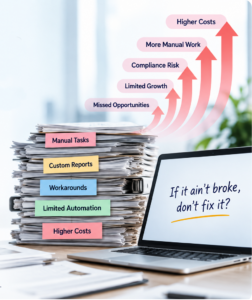
 Modernizing Debt Recovery Without Disrupting Your Business
For many organizations, the thought of replacing an existing debt collection or receivables management system can be overwhelming.
Whether you are a collection agency, financial lender, leasing company, property management organization, or accounts receivable department, your current software likely supports years of established processes, reports, integrations, and business practices.
Even when the system is outdated, difficult to maintain, or limiting your growth, making a change can feel risky.
But what if switching software wasn’t simply about replacing your existing system? What if it was an opportunity to improve how your entire organization operates?
Modern cloud-based platforms like D2R-Collect can help organizations make that transition while creating opportunities for greater efficiency, automation, flexibility, and business growth.
Why Organizations Hesitate to Change
For many organizations, that philosophy has influenced technology decisions for years. If the existing system still performs its basic functions, why take the risk of changing it?
Many businesses recognize that their existing software no longer meets all their needs, yet continue using it because of understandable concerns:
- Implementation costs: Will moving to a new platform require a significant investment?
- Data migration: What happens to years of account histories, notes, payments, and client information?
- Business disruption: Can we continue operating while transitioning?
- Employee training: How long will it take our staff to become productive?
- Existing reports and integrations: Will we lose functionality we’ve depended on for years?
- Custom processes: Can a new system accommodate the way our organization operates?
These are legitimate questions, and they deserve thoughtful answers.
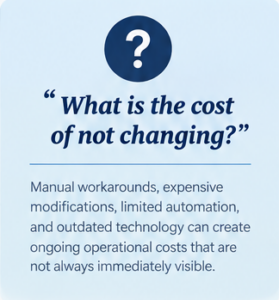
However, there is another question worth considering: What is the cost of not changing?
Manual workarounds, expensive modifications, limited automation, outdated technology, and missed business opportunities can create ongoing costs that are not always immediately visible.
The goal should never be to change software simply for the sake of change. It should be to determine whether a modern platform can deliver greater long-term business value.
Don’t Just Replace Your Existing System—Rethink Your Processes
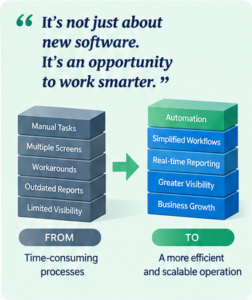
Modernization is an opportunity to work smarter, not just change software.
One of the most common mistakes organizations make when adopting new software is trying to reproduce their existing system exactly as it is.
Over time, older systems accumulate customizations, manual procedures, specialized reports, and workarounds developed to overcome limitations.
Not all of these processes are necessarily still required.
Moving to a modern platform presents an opportunity to ask:
- Can repetitive tasks be automated?
- Can multiple screens or steps be simplified?
- Can existing reports be replaced or enhanced with more useful, real-time information?
- Can business rules be configured instead of relying on custom programming?
- Can collectors, administrators, and managers work more efficiently?
- Can the system support new services, customers, and business models?
- Can a real-time client portal improve transparency, communication, and customer service?
- Can modern technology strengthen our competitive position, scalability, and long-term business value?
The objective is not to lose what works. It is to preserve what matters while improving what can be done better.
This approach can reduce unnecessary customization, simplify implementation, and help organizations take advantage of capabilities that may not have been available in their previous systems.
More importantly, it encourages organizations to look beyond their existing processes and consider new ways of operating.
Data Migration Doesn’t Have to Be a Barrier
For many organizations, historical data is one of their most valuable assets.
Account information, debtor and customer records, payment histories, notes, documents, and collection activity must be handled carefully during any transition.
A successful migration begins with understanding the existing data, identifying what needs to be transferred, and establishing a structured migration and validation process.
With proper planning, testing, and reconciliation, organizations can reduce migration risks and establish a reliable foundation in their new environment.
The important point is that data migration should be treated as a planned implementation activity, not automatically as a reason to avoid modernization.
What About Existing Reports, Integrations, and Custom Work?
This is often one of the biggest concerns for established businesses.
Over the years, organizations may have invested heavily in customized reports, accounting interfaces, client integrations, communication processes, and specialized workflows.
The concern is understandable: Will we have to rebuild everything?
Not necessarily.
The first step should be to review existing functionality and determine what business requirement each component serves.
Some requirements may already be supported by the new platform. Others may be addressed through configuration, standard reporting, workflow rules, or available integrations.
More specialized requirements may need additional development.
It is also important to recognize that adopting a new collection platform does not necessarily mean replacing every application your organization currently uses.
Accounting systems, customer management applications, payment services, communication platforms, and other specialized business tools may continue to play important roles.
A modern platform should support an integration strategy that allows organizations to use the most appropriate technologies for their business, subject to technical compatibility and implementation requirements.
Rather than automatically recreating every legacy feature, the implementation process should identify the most practical and cost-effective way to achieve the desired business outcome.
A modern system should help simplify your operations, not carry forward unnecessary complexity.
Your Team Should Focus on Collections, Not Learning Software
Software adoption is not just a technical project. It is also about people.
Collectors, account managers, administrators, and supervisors need tools that support their daily responsibilities without unnecessary complexity.
An intuitive system, supported by appropriate training and a well-planned transition, can help employees become comfortable with new processes and return their focus to productive work.
However, modernization also creates an opportunity to rethink how people work.
Instead of simply training employees to perform the same tasks in a different application, organizations can evaluate how automation, improved information access, and better workflows can support their teams.
This may involve introducing new responsibilities, improving collaboration between departments, or allowing employees to focus on activities that require human judgment and experience.
Technology should empower your people, not simply change the screens they use.
The goal is to spend less time navigating software and more time managing accounts, communicating with customers, resolving disputes, negotiating payment arrangements, and recovering outstanding balances.
One Platform, Multiple Industries
Debt recovery and receivables management are not limited to traditional collection agencies.
Financial lenders manage delinquent loans and repayment arrangements. Leasing companies track overdue contractual payments. Property management organizations handle rent arrears, damages, and tenant balances. Businesses manage outstanding invoices and aging receivables.
Although each industry has its own requirements, many of the underlying processes are similar:
- Managing accounts and outstanding balances
- Tracking customer communications
- Scheduling follow-ups and payment commitments
- Automating reminders and collection activities
- Monitoring performance and account status
- Providing management and client reporting
- Maintaining security, accountability, and audit histories
- Integrating with internal business applications and external service providers
- Adopting new technologies and specialized solutions as business needs evolve
Organizations should have the flexibility to select technologies that best meet their requirements, rather than being unnecessarily restricted to a single vendor for every business function.
D2R-Collect brings debt recovery and receivables management capabilities together in a configurable cloud-based environment that can support different business models and collection strategies.
Its client portal, workflow configuration, reporting, communications, and integration capabilities can help organizations modernize their operations while maintaining visibility and control.
For organizations that require it, the platform also supports workflows extending into legal recovery and filing activities.
A Modern Platform Should Prepare You for Tomorrow
Replacing an aging system should not be a decision based only on today’s requirements.
Organizations also need to consider how their technology will support them over the next several years.
Automation, intelligent workflows, advanced analytics, and artificial intelligence are creating new opportunities to improve how receivables and debt recovery operations are managed.
D2R-Collect continues to invest in these areas, including its strategy for predictive analytics, AI-assisted communications, and intelligent recommendations.
These technologies have the potential to help organizations better understand account behavior, prioritize activities, evaluate communication effectiveness, and make more informed operational decisions.
The objective is to move beyond repetitive administrative processes toward more intelligent and proactive receivables management.
Choosing a platform with a clear development direction can help businesses prepare for changing operational needs without repeatedly replacing their core technology.
Making the Transition: Start with a Conversation
Every organization has different requirements, and there is no single implementation approach that works for everyone.
A practical transition begins with understanding your current environment, identifying your priorities, and determining which existing processes should be retained, improved, or replaced.
Before making a decision, consider:
- What are the biggest limitations of our current system?
- Which processes are essential to our daily operations?
- What information, reports, and integrations must be preserved?
- Where could automation eliminate unnecessary work?
- What capabilities will our organization need as it grows?
- How can we help our employees adapt, develop new skills, and participate in improving the organization?
These questions help establish a realistic transition plan, including scope, effort, cost, training, and implementation priorities.
They also help ensure that modernization is approached as a business initiative rather than simply an IT replacement project.
Final Thoughts: Change Should Create Opportunity, Not Fear
The decision to replace debt collection or receivables management software should not be driven by technology alone.
It should be driven by the opportunity to improve productivity, simplify operations, strengthen controls, enhance customer service, and position your organization for future growth.
Your existing system may have served your business well for many years. That experience and knowledge remain valuable.
But the processes and technology that supported yesterday’s operations may not be the best foundation for tomorrow’s opportunities.
The goal is not simply to move from one system to another. It is to move your business forward.
Discover What’s Possible with D2R-Collect
Whether you are managing a collection agency, financial lending portfolio, leasing operation, property management business, or accounts receivable department, D2R-Collect can help you explore a more efficient approach to debt recovery and receivables management.
Let us start with a conversation about your current challenges, your existing systems, and what you would like to achieve.
Contact D2R-Collect to schedule a personalized discussion and discover how a modern debt recovery and receivables management platform could support your organization.